Pediatric Healthcare Triage Agent
Pediatric Healthcare Triage Agent
Pediatric Healthcare Triage Agent
Category
Healthcare
Category
Healthcare
My role
Product Concept
My role
Product Concept
Timeline
5 weeks
Timeline
2 weeks

Problem
Postpartum mothers face care.
They end up anxiously Googling, making unnecessary ER trips, waiting on a nurse’s hotline, and looking up existing symptom trackers presented as static information.
Solution
AI nurse triage and care navigation via SMS.
A conversational hotline for postpartum and infant health: message it like a contact, and it instantly triages concerns while handling logistics such as booking pediatrician appointments in real time, verifying insurance coverage, looping in existing care teams, and adding it all to your calendar.
Process
Competitive Audit
No current solution assesses issues and books an appointment. A triage AI agent closes that gap by handling assessment and scheduling in one conversation, so a parent messaging at 11 pm can get an urgency read, a verified appointment, and a confirmed copay.

Problem
Postpartum mothers face care.
They end up anxiously Googling, making unnecessary ER trips, waiting on a nurse’s hotline, and looking up existing symptom trackers presented as static information.
Solution
AI nurse triage and care navigation via SMS.
A conversational hotline for postpartum and infant health: message it like a contact, and it instantly triages concerns while handling logistics such as booking pediatrician appointments in real time, verifying insurance coverage, looping in existing care teams, and adding it all to your calendar.
Process
Competitive Audit
No current solution assesses issues and books an appointment. A triage AI agent closes that gap by handling assessment and scheduling in one conversation, so a parent messaging at 11 pm can get an urgency read, a verified appointment, and a confirmed copay.
Main Flow
One question at a time, urgency assessed against AAP guidelines and sorted into four levels. The system avoids over-alarm and over-caution, naming what it can’t see to build trust. Once confirmed, it checks provider availability, verifies copays, and routes to care. It sends a symptom log ahead, sets reminders, and re-assesses if symptoms worsen.

Main Flow
One question at a time, urgency assessed against AAP guidelines and sorted into four levels. The system avoids over-alarm and over-caution, naming what it can’t see to build trust. Once confirmed, it checks provider availability, verifies copays, and routes to care. It sends a symptom log ahead, sets reminders, and re-assesses if symptoms worsen.
Model Behavior
The system prompt hard-codes: one question per message, AAP-based urgency levels, visible reasoning before any recommendation, and bans unverified appointments or diagnoses. Each constraint maps to a failure mode it prevents — one question avoids overwhelming users, AAP thresholds prevent the trust erosion of defensive "just go to the ER" caution, and visible reasoning shows the system evaluated the full picture rather than jumping to a verdict. If new symptoms arrive mid-conversation, the same prompt logic forces a reversal rather than letting the original assessment stand.
Model Behavior
The system prompt hard-codes: one question per message, AAP-based urgency levels, visible reasoning before any recommendation, and bans unverified appointments or diagnoses. Each constraint maps to a failure mode it prevents — one question avoids overwhelming users, AAP thresholds prevent the trust erosion of defensive "just go to the ER" caution, and visible reasoning shows the system evaluated the full picture rather than jumping to a verdict. If new symptoms arrive mid-conversation, the same prompt logic forces a reversal rather than letting the original assessment stand.
Preventing Hallucinations
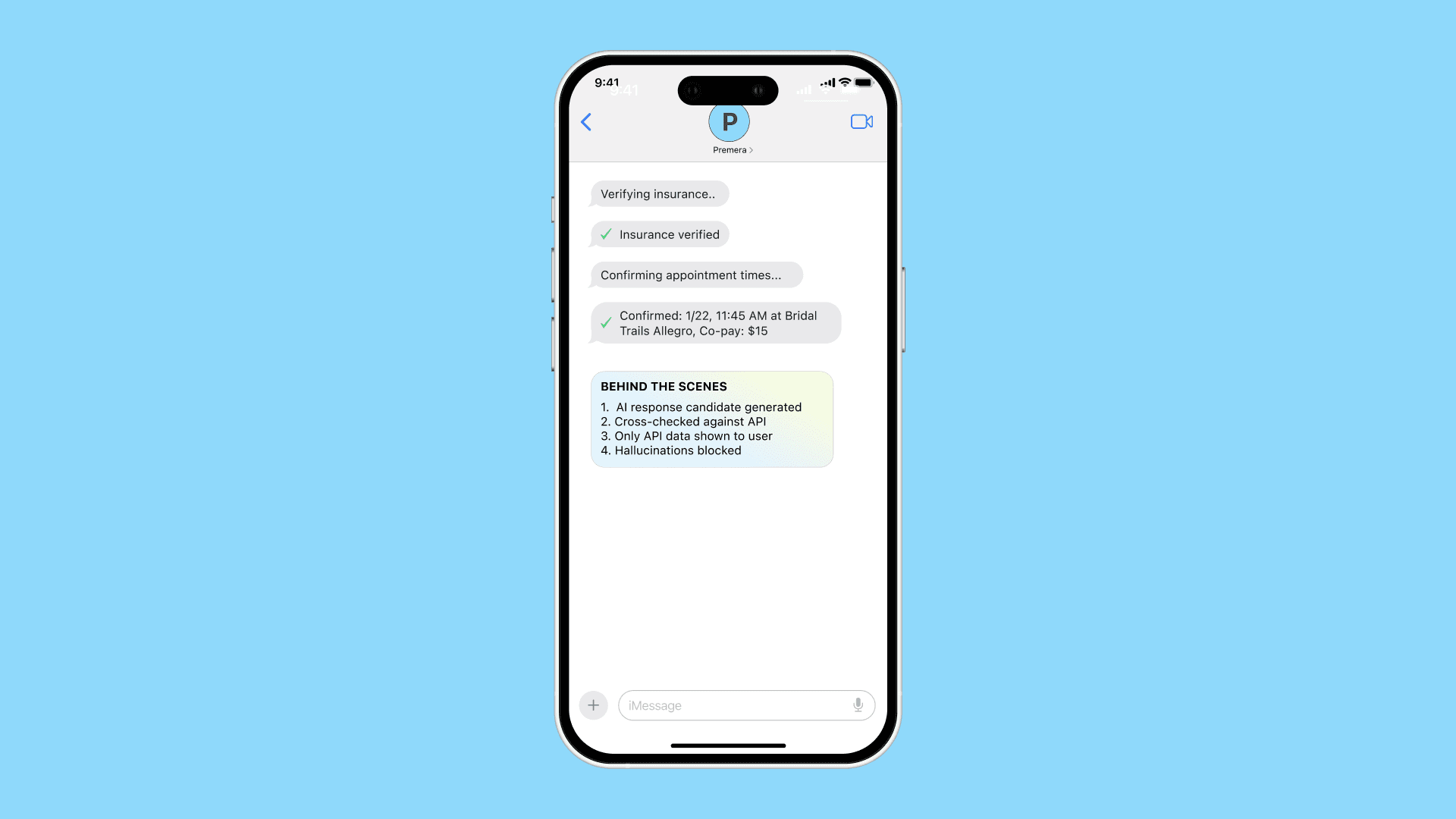
The system is built with three checks before anything reaches the user: it only shows appointment times pulled directly from the API verified scheduling system, it double-checks that each appointment actually exists in the provider's database, and it scores its own confidence in the result, sending anything uncertain to a human for review instead of guessing.
Preventing Hallucinations
The system is built with three checks before anything reaches the user: it only shows appointment times pulled directly from the API verified scheduling system, it double-checks that each appointment actually exists in the provider's database, and it scores its own confidence in the result, sending anything uncertain to a human for review instead of guessing.
Reflections
As a new parent, I wanted an AI solution that made healthcare questions and follow-up scheduling more efficient. Domain knowledge helped me question the AI's assumptions. A functional prototype wasn't possible because of HIPAA restrictions and the lack of real member data, insurance APIs, and scheduling infrastructure, so I built a high-fidelity Figma prototype instead. The project surfaced the need for an agentic system that knows your plan, doctors, and medical history. The real challenge was making it feel trustworthy for real world use.
Reflections
As a new parent, I wanted an AI solution that made healthcare questions and follow-up scheduling more efficient. Domain knowledge helped me question the AI's assumptions. A functional prototype wasn't possible because of HIPAA restrictions and the lack of real member data, insurance APIs, and scheduling infrastructure, so I built a high-fidelity Figma prototype instead. The project surfaced the need for an agentic system that knows your plan, doctors, and medical history. The real challenge was making it feel trustworthy for real world use.

